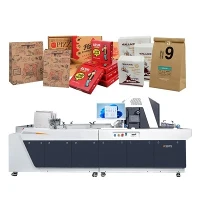
Single Pass Printer
Print Head: A3 Printhead / 841 Industrial Printhead
Print Tech: Thermal foam technology
Ink Type: Thermal foaming CMYK water-based ink
Applicable Industries: Printing factory, Carton factory, Paper bag factory, Cardboard factory, Paper cup factory, Paper box factory, Advertising printing, Kraft paper factory
Use: Corrugated box printer, Cardboard printer, Paper bag printer, Box printer, Pizza box printer, Paper cup fan printer, Paper Printer

- Product Introduction
Product Parameters
|
Product Name |
Single pass printer |
|
Print Head |
A3 Printhead / 841 Industrial Printhead |
|
Print Tech |
Thermal foam technology |
|
Ink Type |
Thermal foaming CMYK water-based ink |
|
Applicable Industries |
Printing factory, Carton factory, Paper bag factory, Cardboard factory, Paper cup factory, Paper box factory, Advertising printing, Kraft paper factory |
|
Use |
Corrugated box printer, Cardboard printer, Paper bag printer, Box printer, Pizza box printer, Paper cup fan printer, Paper Printer |
|
Resolution |
600*1200DPI |
|
Printing Speed |
10-40m/min |
|
PC System |
Win10/Win11 |
|
Language |
English (customize is available) |
|
Image Format |
BMP/JPG/PDF/TIFF |
|
Data Transmission |
USB3.0 |
|
Ink Detection |
Ultrasonic liquid level detection |
|
Ink Supply Method |
Continuous ink supply |
|
Software |
kelier3.0 |
|
Conveyor Platform |
Vacuum negative pressure |
|
Machine Structure |
Aluminum alloy + steel structure |
|
RIP |
Software startup(Flexi21)USA |
|
Sense Method |
Infrared photoelectric sensor |
|
Use Requirements |
Room TEMP 15-35°C, humidity 20%-80% |
|
Print Height |
0.5-3mm (from head to print surface) |

Product Description


Single Pass Printer
We build the single-pass platform to order rather than as a fixed catalog machine. Mold changes, cabinet color and frame dimensions are open to OEM/ODM, and the print width can be set anywhere from 12.9 cm to 186 cm so the unit drops into an existing conveyor or finishing line. The trade-off is straightforward: a wider frame changes tension and vacuum requirements, so the frame, fan and belt are matched to the width class during OEM review, not after the fact. Printheads, ink type, and the feed and drying configuration are chosen against the actual job mix.
On the electronics side, an industrial controller runs motion, while data handling is done by FooFon 3.0, our self-developed RIP and print-management software, with USB 3.0 as the upload link. Because FooFon 3.0 is developed in-house, we tune the RIP pipeline and variable-data engine against real production jobs instead of relying on a generic third-party driver. The point of that pairing is consistent throughput rather than a peak-speed number - a BMP/JPG/PDF/TIFF file, including short-run, on-demand or personalized variable-data work, is rendered and transferred with less waiting between files. On long runs, that waiting is where most "the machine paused" complaints actually come from. It also means feature requests and on-site issues go straight to our own development team rather than into a vendor's support queue.
Daily reliability is mostly a head-care problem. One key press runs the automatic cleaning cycle to clear dried ink before it becomes a clog, and an optional auto-lifting module sets the head-to-media gap from 0.5 to 3 mm across media from 0.1 to 20 mm thick.
We specify HP 841 industrial heads rather than office-grade A3 heads, and the reason is electrical and hydraulic, not cosmetic. A3 heads use a thin single-sided flex cable; under 24/7 duty that contact becomes a single point of failure. The 841 uses a wider double-sided contact cable, which lowers contact resistance and makes failures from oxidation or voltage sag far less likely. Its nozzles are also finer, producing smaller drops and a higher native resolution, so gradients stay smooth and small text stays clean. On the ink side, the shorter, taller ink sac keeps pressure and flow steadier, and the ink path is shaped to trap air before it reaches the head - the "air clog" that ends an A3 head's week. The 841 is designed around years of continuous commercial duty and a lower cost per page. It is not a better A3; it is a different component class.
The frame uses a proprietary structure intended to take vibration out of the print zone at speed. Less vibration means less wear on the head and encoder path, and that is what extends head life and lowers maintenance cost over a year. With that structure and the feed system, the line holds an actual production speed of 10–40 m/min, depending on stock and job.
Ink is CMYK, in dye or pigment versions, formulated to dry on contact and to stay within EU REACH and RoHS limits rather than merely claiming "green." Output is 600×1200 or 1200×1200 dpi, with color that reads as high saturation; at these resolutions short-run packaging gets an offset-like dot look without plate cost. A continuous ink supply keeps the heads fed during long runs.
Registration is a vacuum problem before it is a software problem. A high-output fan pulls through the belt, and the precision vacuum conveyor holds negative pressure across the full belt width so the sheet stays flat at line speed. That is what removes the micro-shifts that show up as blurred dots or doubled edges on real, slightly varied board - the kind of variation actual cartons have, not lab samples.
The intended work is packaging: corrugated cartons, paper bags and pizza boxes, plus paper cups and take-away packaging. Substrates include paper, corrugated board, bags, cup fan, non-woven bags and other permeable materials, and the line handles light or coated paper without fiber warping.
Hot Tags: single pass printer, China single pass printer manufacturers, suppliers, factory, Cardboard Food Box Printing Machine, Single Pass Industrial Printing System, Single Pass Printer, Single Pass Printing Machine, Single Pass Printing Press, Single Pass Production Printer